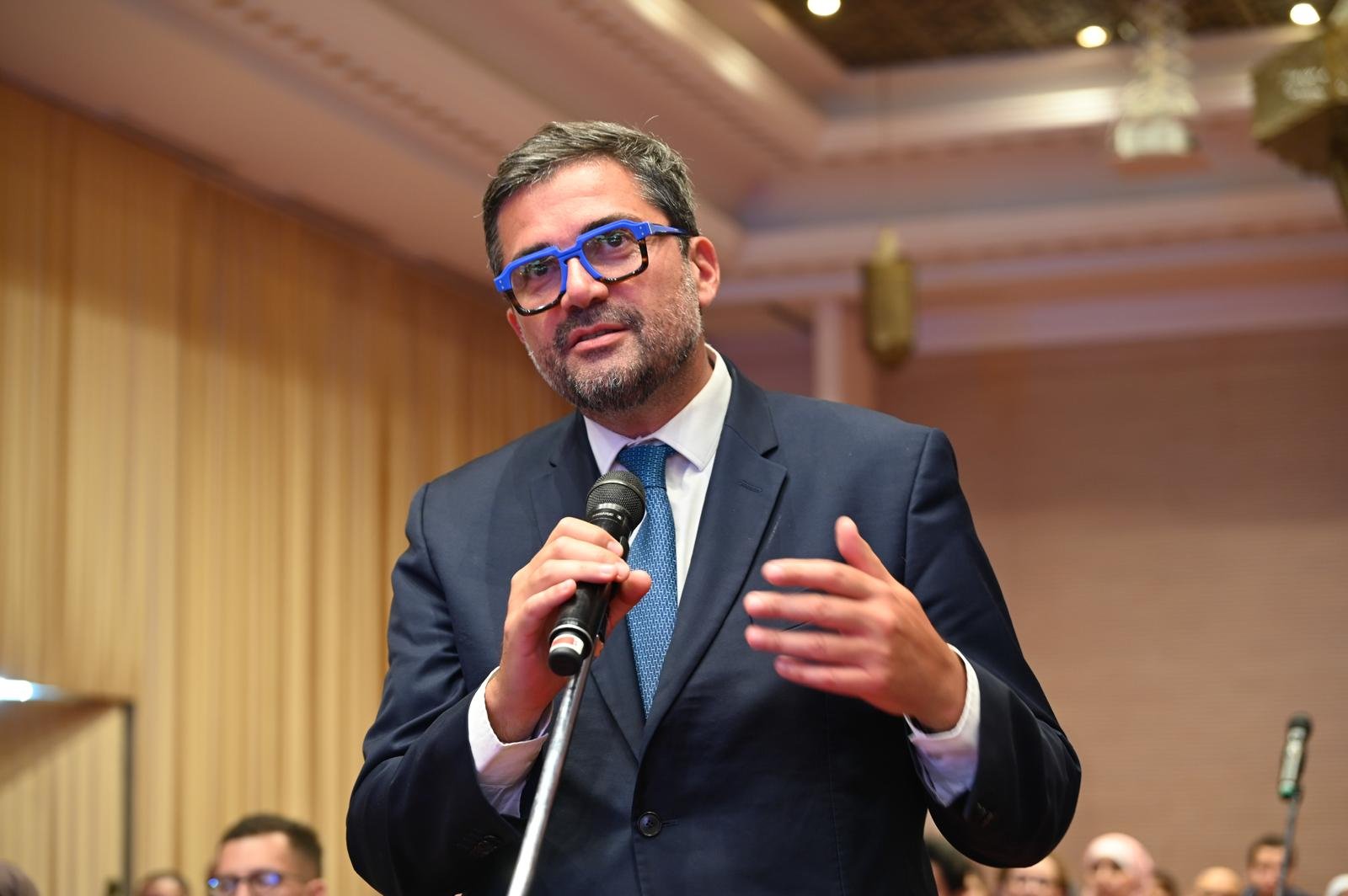
As Yerevan opens its doors to COP17, the United Nations conference on biodiversity¹, we sat down with Professor David Smadja, a French physician who has become one of the strongest voices linking environmental protection and human health. We wanted to hear what he thinks about the challenges facing greenhouse farmers in the Ararat region, and what Armenia could do next.
Professor Smadja is Professor of Hematology at Université Paris Cité and Head of the Hematology Department at the European Georges-Pompidou Hospital in Paris. He also leads the Health Commission of the French think tank Le Laboratoire de la République. We spoke with him about our joint survey with HayMed NGO in the Ararat greenhouses², and about the wider questions it raises for Armenia.
One idea ran through our whole conversation: protecting the environment and protecting human health are not two separate goals, but one.
A scientific encounter that became a commitment
Professor Smadja’s connection to Armenia began almost by chance. In winter 2025, he came to Yerevan to speak about thrombosis and cancer at the first French-Armenian Hematology Conference, organized by the association Transplant to Armenia. During that visit, the organizer, Gérard Hovakimian, showed him some of the realities on the ground, including the problems linked to pesticide use in agriculture.
The timing was right. In France, he had just begun working on environmental health. “What had previously been a subject of reflection in public health policy suddenly acquired a very tangible dimension,” he told us.
For him, this reflects a deep change in how medicine understands health. It is no longer only about diagnosis and treatment. Our health also depends on the air we breathe, the water we drink, the food we eat and the conditions in which we work. In Armenia, he says, farming practices, working conditions and natural resources are closely tied to the health of the population.
He was clear that solutions must come from Armenia itself: “The objective is not to import a theoretical model, but rather to start from local realities and develop appropriate, practical responses.”
Rigorous science, shared responsibility
When we discussed our survey, Professor Smadja insisted on one thing above all: scientific rigor. He sees our findings as important signals that deserve serious attention and justify prevention, while being honest that a survey of this kind cannot prove what caused each health problem reported.
He warned against two opposite mistakes: playing down real risks³, and spreading fear that is not backed by evidence. “Environmental health cannot be driven by fear, political agendas, or selective interpretations of scientific evidence,” he said. Yet caution should not become a reason to wait. “Scientific rigor must never become an excuse for inaction.”
What struck us most was his refusal to put the burden on farmers alone. “We cannot ask workers to protect themselves more effectively without providing access to appropriate protective equipment,” he told us. “We cannot recommend better waste management without establishing accessible collection systems.” For him, prevention must be a collective effort, shared by scientists, doctors, farmers and public authorities.
He often returns to two ideas. The first is the exposome: everything a person is exposed to over a lifetime, at home and at work. Doctors, he believes, should routinely ask patients about their occupation, especially agricultural workers. The second is One Health: the recognition that the health of people, animals and ecosystems is deeply connected, which means doctors, agronomists, researchers and authorities must learn to work together.⁴
COP17 as a turning point
Professor Smadja sees COP17 as a real opportunity for Armenia. Biodiversity conferences are often seen as diplomatic events, he noted, yet protecting water, soils and ecosystems is also a way of protecting people. Countries have already committed, under the Kunming-Montreal Global Biodiversity Framework, to halve the overall risk from pesticides and highly hazardous chemicals by 2030.⁵ Armenia, he believes, could show how such a commitment translates into real benefits for public health.
His proposal is concrete: a pilot environmental health programme in the Ararat region, built together with local authorities, farmers, workers, health professionals and organizations already active there. It would combine practical training, access to protective equipment and safe storage, a collection system for pesticide containers, independent agricultural advice and support for safer alternatives, along with monitoring to measure progress.
He also sees a role for hospitals, which should help prevent disease and not only treat it. Together with Marin de Nebehay, he has championed the idea of an “Environmental Health Hospital”⁶, and he would like French and Armenian medical teams to share experience in this area, on Armenia’s own terms.
To make this last, he proposes a joint Franco-Armenian parliamentary working group on environmental health, biodiversity and prevention, linking the France-Armenia friendship groups of the French National Assembly and Senate with the Armenia-France group of the Armenian Parliament. Its role would be to support the Ararat pilot, find funding and evaluate the results openly.
A legacy in real places
At the end of our conversation, we asked Professor Smadja what he hopes COP17 will leave behind. His answer was simple and practical: “a greenhouse where workers are better protected, a healthcare center where occupational exposures are more systematically considered, or a community where local stakeholders have the resources to prevent risks.”
He left us with a sentence that sums up why this work matters to us: “Protecting the land and protecting those who cultivate it must become two inseparable dimensions of the same public health ambition.”
At Maqoor NGO, together with our partners at HayMed NGO, we share that ambition. We thank Professor Smadja for his time, his insight and his support, and we look forward to working with doctors, authorities and farmers to turn these ideas into action in the Ararat region.
References
- Convention on Biological Diversity. COP17, Yerevan, 19–30 October 2026.
- HayMed and Maqoor. Analysis Report of the Survey Data on Pesticide Use Practices in Greenhouses in the Ararat Region, 64 pages, with a 3-page analytical summary note.
- World Health Organization. Pesticide residues in food, 15 September 2022.
- David Smadja and Marin de Nebehay. Environmental Health: Training to Transform. Skills Development as a Condition for Collective Action. Terra Academia / IHETE, April 2026.
- Convention on Biological Diversity. Kunming-Montreal Global Biodiversity Framework, Target 7.
- David M. Smadja and Marin de Nebehay. Towards a French “Environmental Health Hospital” Label for Sustainable and Responsible Healthcare. Annales Pharmaceutiques Françaises, 2026.